


Key Takeaways
- Tracify's core technology is a granted US patent (US 12,405,969 B2, September 2, 2025, assignee Tracify GmbH). A granted patent is an examined, publicly documented method – not a marketing promise.
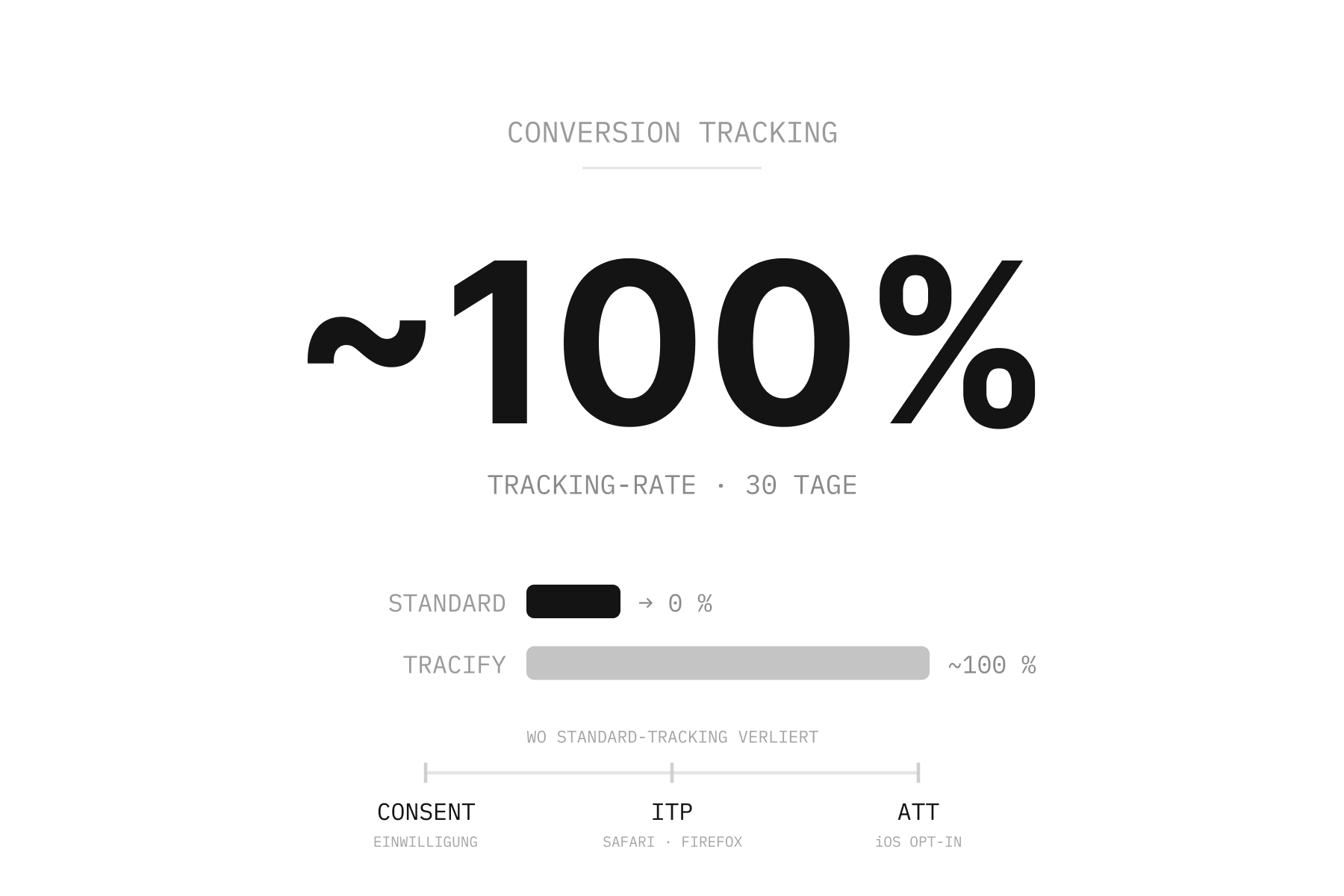
- The patent addresses exactly the problem where standard tracking fails: journeys fragment due to cookie lifetimes, blockers, consent, and above all device, browser, and network switches.
- The solution is an anonymous, AI-powered matching that assigns data fragments to the right person (an "identification group") – without reconstructing the true identity.
- The patent protects the method, not specific metrics. It proves the novelty and inventive step of the method – performance figures such as tracking rates remain untouched by it.
Tracify's core technology is patented
On September 2, 2025, the US Patent and Trademark Office (USPTO) granted patent US 12,405,969 B2, titled "System for Providing Tracking Data." The assignee is Tracify GmbH (Munich); the named inventors are Markus Rohm and Marius Rudolf; priority dates back to a European application filed December 3, 2021. The patent comprises 19 claims.
A granted patent is more than a label. The USPTO examines an application for novelty and inventive step – an examiner has to confirm that the method is new and non-obvious. For you as a user, that means: the technology underlying Tracify's measurement is an examined, publicly documented method – not a promise you simply have to believe.
The problem: why customer journeys fragment
A customer journey is rarely a continuous line. In practice it fragments into pieces – and that is exactly the starting point the patent describes. The reasons:
- Cookie lifetimes and blockers. Cookies have short lifespans and are restricted by browsers and blockers. If the identifier is gone, the trace breaks.
- Device switches. Someone discovers a product on their smartphone and buys later on the desktop. To a cookie-based setup, those are two unrelated people.
- Network and browser switches. Switching from mobile data to Wi-Fi, a VPN, or a different browser can make the same person look like several unconnected users.
- Breaks and consent. If a user interrupts their session or declines tracking, further gaps appear.
The result: you capture many individual fragments, but not the one coherent journey. And correctly reuniting these fragments is – as the patent puts it in essence – the actual challenge.
What Tracify patented – explained simply
The patented method solves exactly this reuniting. The process can be described in four steps:
- Capture signals, not persons. An interaction produces a dataset of many technical characteristics – in the patent "entity identifiers," or a "footprint" of hardware, script, and action characteristics (such as device and browser properties or characteristic usage patterns). These are deliberately anonymous signals, not real names or account data.
- Form an anonymous identifier. From these signals an anonymized tracking identifier (a UUID or a hash) is generated that specifically does not reveal the person's true identity.
- Form identification groups. The system forms "identification groups" – reduced, anonymous representations per person. They are designed so that no personal information can be reconstructed from the data they contain. Data protection is thus built into the method, not bolted on afterwards.
- Assign fragments to the right person. Using a similarity measure – at its core a distance between datasets in a parameter space – the system assigns each new fragment to the best-matching identification group. If nothing fits closely enough, a new group is created; if it turns out that two groups are the same person, they are merged. A machine learning module learns the patterns and becomes more precise as the amount of data grows.
In short: the patent describes an anonymous, AI-powered matching that assigns fragmented data traces to the same person without identifying that person.
Three properties that make the difference
Three properties follow from the method that set it apart from cookie-based standard tracking:
- Across devices and sessions. Because the assignment doesn't hang on a single cookie but on the similarity of many signals, a journey can be reunited into one person across devices, browsers, and sessions. Switching from smartphone to desktop no longer breaks the journey.
- Without login and without an account. The method works explicitly independently of login or account information. It needs no logged-in account to connect fragments.
- Privacy by design – designed to work without a consent opt-in. The data is anonymized early (in the patent, among other things via a gate module with a reverse proxy), and deliberately only signals that don't require consent are processed. That is the methodological reason why the method is designed to work without a consent opt-in.
How it all works together in Tracify's product
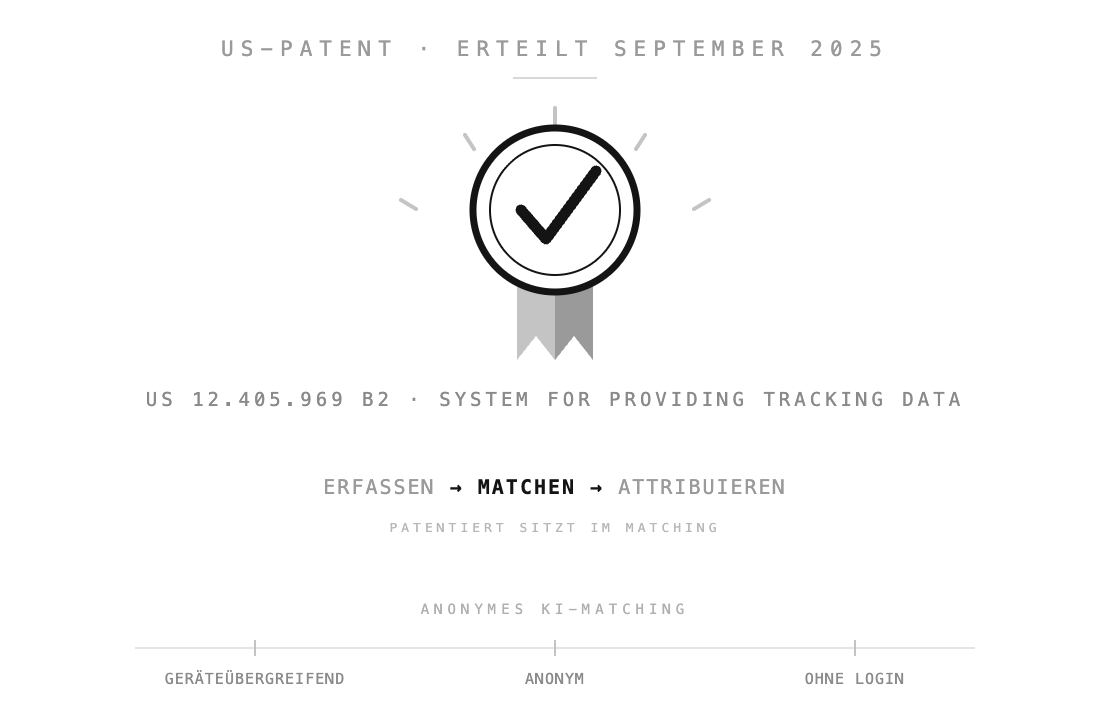
Attribution is ultimately a question of data quality, and that arises in three steps: capture, match, attribute. The patent sits at the heart of it – the matching.
- Capture: Hybrid tracking captures as many touchpoints of a journey as possible.
- Match: the patented AI matching reunites the fragments into the right person across devices and sessions. This is exactly where the protected method takes effect.
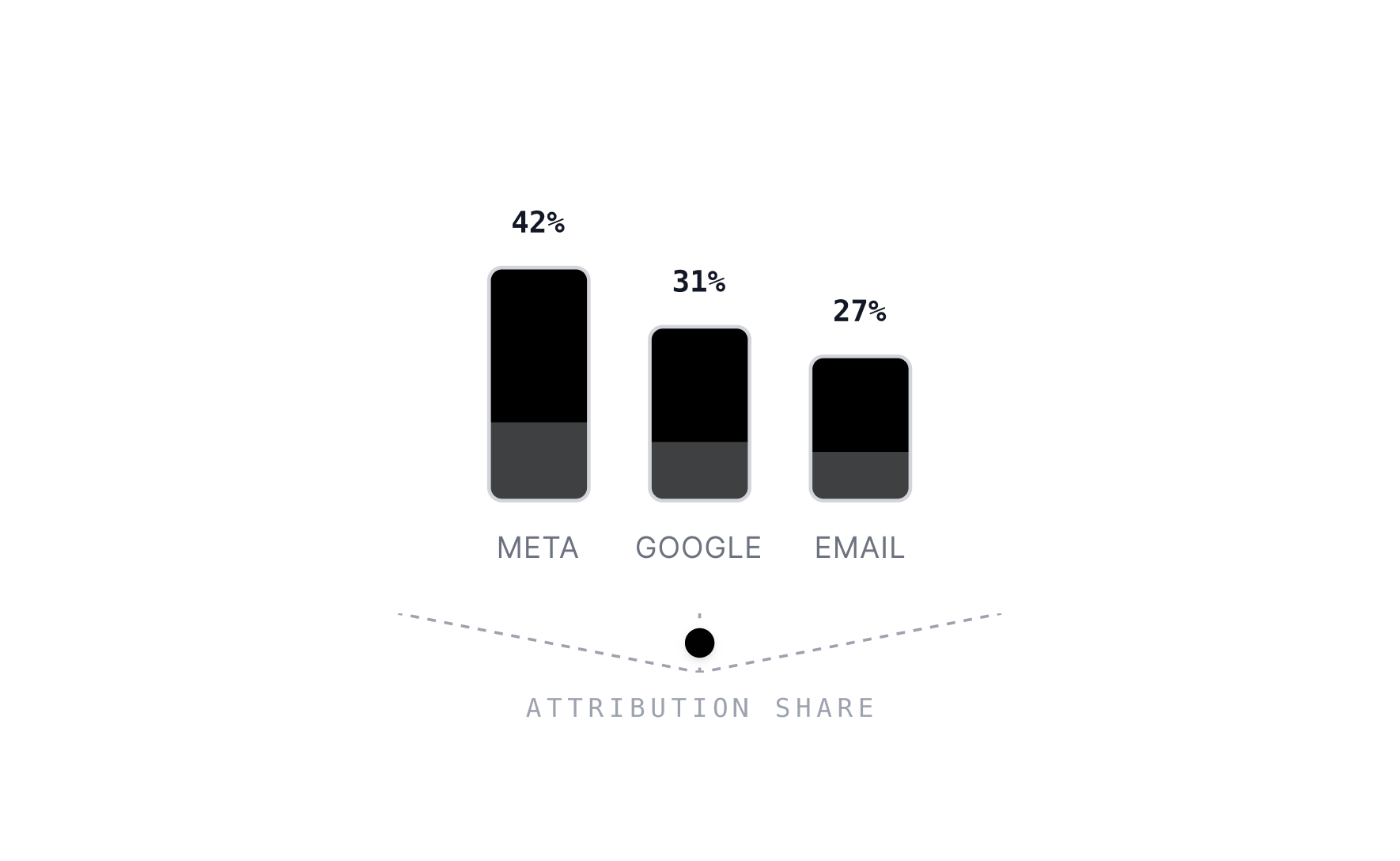
- Attribute: on this more complete basis, the behavior-based AI attribution evaluates the true, incremental contribution of each touchpoint – not just a learned correlation weight.
The common thread: a touchpoint you don't capture can't be assigned to any journey; what isn't assigned can't be attributed correctly. Matching is the bottleneck – and that's exactly where the patent takes effect. For how attribution works in general, see the overview of marketing attribution.
Why a patent matters for you as a user
- Verifiable instead of claimed. A granted patent is publicly accessible and was examined by an authority. Instead of "we track better," there is a documented method you can read up on.
- Examined differentiation. Novelty and inventive step are prerequisites for a grant. The method is therefore demonstrably not what standard tools do anyway.
- Data protection as a design principle. Anonymization and reduced representation are part of the method, not an afterthought filter.
What the patent does not mean
To keep the classification honest: a patent protects a method – it does not guarantee specific metrics. It proves that the method is new and non-obvious, not that a specific tracking rate is reached in every setup. Figures such as near-complete capture over 30 days remain empirical values from real-world operation, not a statement of the patent. And a patent makes no conclusive data protection assessment for an individual case. This distinction matters to us because it marks the difference between examined technology and marketing.
See the patented technology in action
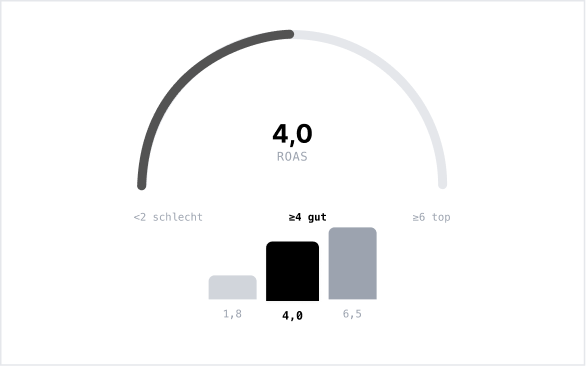
Capture customer journeys across devices, anonymized and on German servers – the basis for reliable ROAS, CAC, and attribution figures.
Discover hybrid trackingConclusion
With US 12,405,969 B2, the method that forms the core of Tracify's measurement is protected: the anonymous, cross-device and cross-session reuniting of fragmented customer journeys – without a login and designed to work without a consent opt-in. For you, this means one thing above all: the data quality on which ROAS, CAC, and attribution build rests on an examined, documented method – not on a promise.
Frequently asked questions
What did Tracify patent?
A method for providing tracking data that assigns fragmented customer journeys to a single person across devices and sessions, anonymously. It is described in US patent US 12,405,969 B2, titled "System for Providing Tracking Data."
When and by whom was the patent granted?
The patent was granted on September 2, 2025, by the United States Patent and Trademark Office (USPTO). The assignee is Tracify GmbH; the named inventors are Markus Rohm and Marius Rudolf.
Does the patent mean tracking without consent is allowed?
The patented method is designed to work without a consent opt-in because it anonymizes data early and only processes signals that don't require consent. Whether a specific setup may legally be operated without consent, however, depends on the implementation and legal situation and is a legal, not a patent-law, question.
How does the cross-device matching work?
Instead of relying on a single cookie, the system forms an identifier from many anonymous signals and assigns new data fragments to the matching identification group via a similarity measure. This makes it possible to reunite a journey across devices and sessions without identifying the person.
Is a login required for this to work?
No. The method works explicitly independently of login or account information.
Does the patent prove a specific tracking rate?
No. A patent protects the method and proves its novelty and inventive step. Specific metrics such as tracking rates are empirical values from real-world operation and not a statement of the patent.
Patent US 12,405,969 B2 – original wording & full text
System for Providing Tracking Data · granted 09/02/2025 · assignee Tracify GmbH, Munich · inventors Markus Rohm & Marius Rudolf · Application No. 18/389,180 (filed 11/13/2023) · priority EP 21212384.8 (12/03/2021) · 19 claims, 5 drawing sheets.
Abstract (original wording): "A system for providing tracking data includes a processing component configured to: receive an event dataset including a plurality of entity identifiers, generate a tracking identification based on the entity identifiers, generate a plurality of identification groups based on a subset of entity identifiers, determine a similarity measure between the tracking identification and an identification group of the plurality of identification groups, and assign the tracking identification to one of the identification groups based on the similarity measure."
Sources
- United States Patent and Trademark Office – Patent US 12,405,969 B2, "System for Providing Tracking Data," granted 09/02/2025, assignee Tracify GmbH, inventors Markus Rohm and Marius Rudolf, 19 claims. Patent as PDF.
- Market context on signal loss (documented in other Tracify articles): Apple/WebKit – Intelligent Tracking Prevention (7-day cookie cap); AppsFlyer (2025) – ATT opt-in DE ~47%; StatCounter – browser market shares DE.