



The customer journey is the entire journey a customer takes from first becoming aware of your brand all the way to purchase, including every point of contact (touchpoint) along the way. It moves through phases, from initial awareness through consideration to conversion, but today it is rarely a straight line and instead loops across many channels. Whoever understands this journey and measures it end to end knows which touchpoints truly drive revenue, and steers budget toward where it works.
In this article you will learn what the customer journey is, which phases and touchpoints it covers, why it rarely runs in a straight line and, the point where most teams fail, how to make the whole journey visible despite data-privacy gaps.
Key Takeaways
- The customer journey covers every touchpoint from first awareness to purchase, not just the last click before the sale.
- For performance marketing, the three phases up to purchase matter most: awareness, consideration and conversion.
- Modern journeys are not linear: according to Google, customers move back and forth repeatedly in the "Messy Middle" between exploring and evaluating, across an average of around 8 channels.1,3
- After ATT and mandatory consent, a large share of this journey is invisible to standard analytics, and in Germany the iOS opt-in rate sits at just 47 percent.4
- Only with complete, GDPR-compliant tracking and data-driven attribution can you measure the whole journey and steer budget precisely.
What is the customer journey?
The customer journey describes the entire path a person travels from first contact with your brand through purchase to long-term loyalty. Every single point of contact along the way, whether an Instagram ad, a Google search, a newsletter or customer service, is a touchpoint.
The concept is by no means new: it traces back to the AIDA model (Attention, Interest, Desire, Action), which E. St. Elmo Lewis formulated around 1898 to describe the path from first attention to the act of purchase. For performance marketers, it is precisely this path up to conversion that matters, because this is where budget decisions are made.
The phases of the customer journey
Classic models divide the customer journey into several phases.6 For steering performance marketing, the three phases up to purchase matter most, because this is where you decide where the budget flows. Each has its own goal, its own customer mindset and its own set of suitable channels:
| Phase | What the customer does | Typical touchpoints |
|---|---|---|
| 1. Awareness | becomes aware of a problem or of your brand | Social ads, SEO, influencers, display |
| 2. Consideration | compares options and does research | Product pages, reviews, newsletter, retargeting |
| 3. Conversion | makes the purchase decision | Checkout, brand search, live chat |
Why the customer journey rarely runs in a straight line
The phase model is a useful map, but reality is messier. Google describes the purchase decision in its "Messy Middle" model: between the first trigger and the purchase, people move back and forth repeatedly between two modes, exploring (finding more options) and evaluating (narrowing options down), often over days and across many channels.3
Just how broad this path is shows up in a figure from Salesforce: consumers interact with companies across around 8 channels on average, and business customers across about 10.1 A journey is therefore not a single click but a whole chain of contact points that stretches across devices and platforms. Treat it as a straight funnel and you are measuring past reality.
Customer journey touchpoints: the contact points that count
Not every touchpoint carries the same weight. Some kick off the journey in the first place, others provide the final nudge. In e-commerce journeys, these contact points tend to have the greatest impact:
- Product pages: description, images and reviews often decide the purchase.
- Cart-abandonment emails: automated reminders that win back lost revenue.
- Social media engagement: likes, comments and shares build trust and reach.
- Retargeting ads: re-engage users who are already interested.
- Live chat: real-time support answers open questions and helps close the sale.
- Influencer mentions & reviews: trusted recommendations strongly influence purchase decisions.
- Checkout: a fast, frictionless payment process reduces drop-offs.
The art is figuring out which of these touchpoints actually trigger conversions in your journey, rather than just guessing. That is exactly what a clean touchpoint analysis delivers: it turns a gut feeling into a solid basis for decisions.
Why focusing on high-impact touchpoints pays off
Concentrating your marketing on the highest-impact contact points, instead of spreading budget thin, wins on several fronts at once:
- Higher ROI: budget flows into the interactions that actually trigger conversions, instead of low-impact channels.
- More targeted personalization: at the decisive touchpoints you can serve content and offers with pinpoint accuracy.
- Better customer experience: frictionless, relevant contact points raise satisfaction and retention.
- Faster decisions: when you know which touchpoints work, you can reallocate budget in an agile, data-driven way.
- Competitive edge: understanding your own journey sets you apart from competitors who optimize blind.
Why the journey decides your budget
The central marketing question is: where does the next dollar go? Without an understanding of the customer journey, you invest blind, perhaps in channels that barely move the needle, while the real revenue drivers stay underfunded.
Understand the journey and you can steer budget toward where it has the greatest leverage. Research on personalization shows this pays off: according to McKinsey, companies that consistently align their customer outreach with the journey typically generate 10 to 15 percent more revenue.2 The leverage lies not in more budget, but in better-placed budget.
The problem: most of the journey stays invisible
Here comes the catch that most guides leave out: understanding the customer journey requires being able to see it at all. And that is exactly what can no longer be taken for granted since the data-privacy upheavals of recent years.
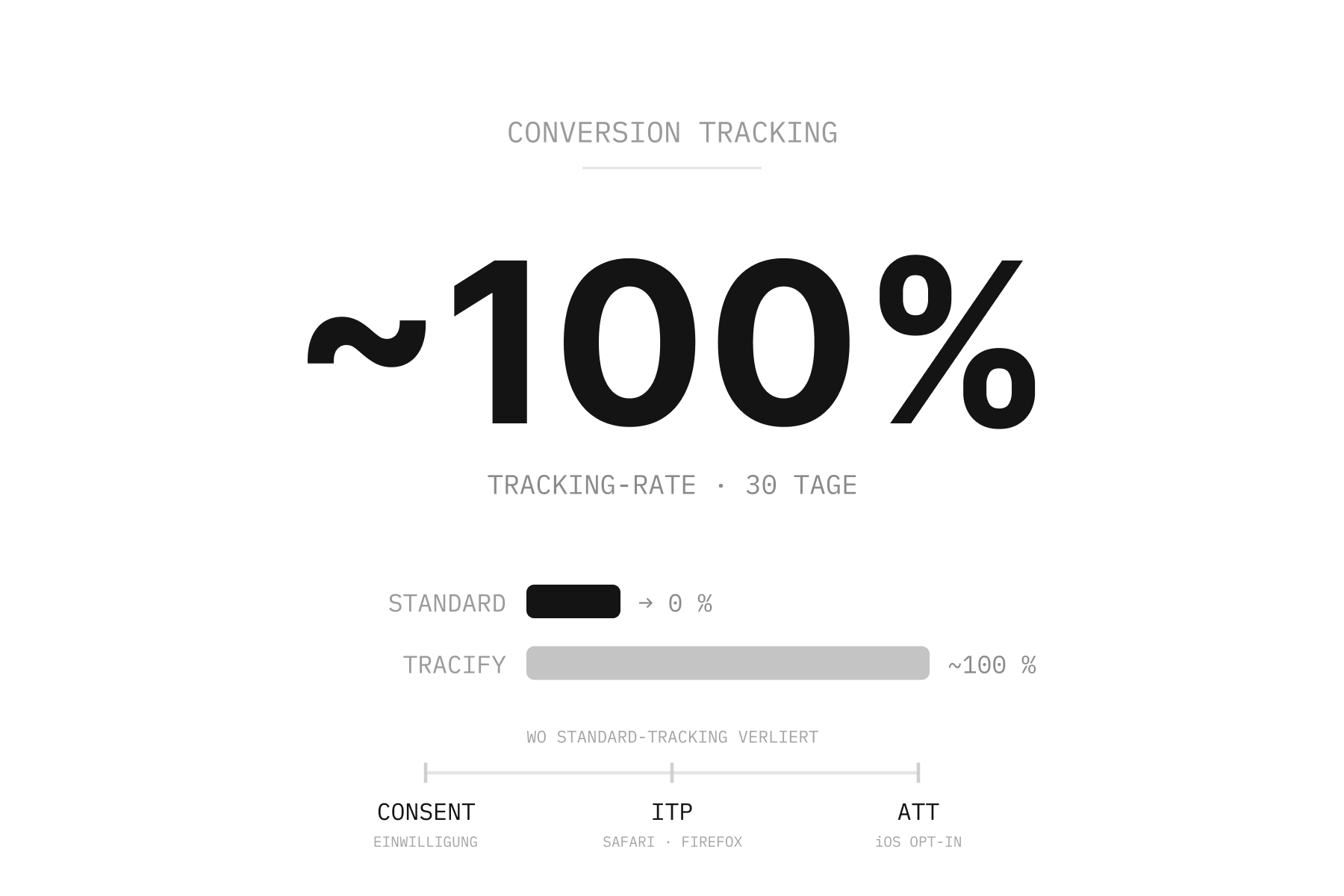
Since Apple's App Tracking Transparency (ATT) and mandatory consent, a substantial share of contact points is missing from standard reports. In Germany, the ATT opt-in rate was just 47 percent in early 2024 according to AppsFlyer4, so roughly half of iOS journeys can no longer be traced on an ID basis at all. Meta put the revenue impact of ATT at roughly US$10 billion for 2022 alone.5 But if half the touchpoints are missing, every journey analysis is patchwork, and every budget decision a guessing game.
Tracking and analyzing the customer journey
To make the whole journey visible, you need two things: data collection that works even without consent to third-party cookies, and attribution that fairly weighs the contribution of every touchpoint. This is exactly where Tracify comes in.
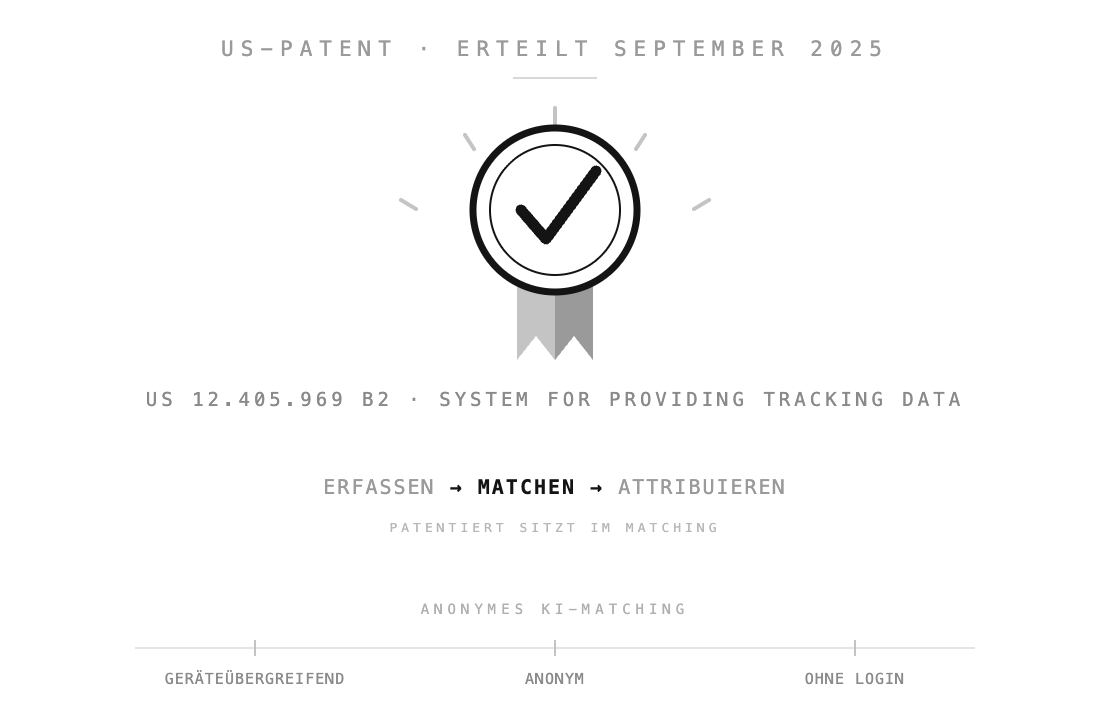
Instead of relying on consent-dependent cookies, Tracify captures customer journeys via a patented, consent-free hybrid tracking, certified as consent-free by the BISG and processed exclusively on German servers. According to Tracify, this brings up to 40 percent more relevant data points into the system, at a tracking rate of nearly 100 percent over 30 days, while classic setups lose toward zero over the same period.7
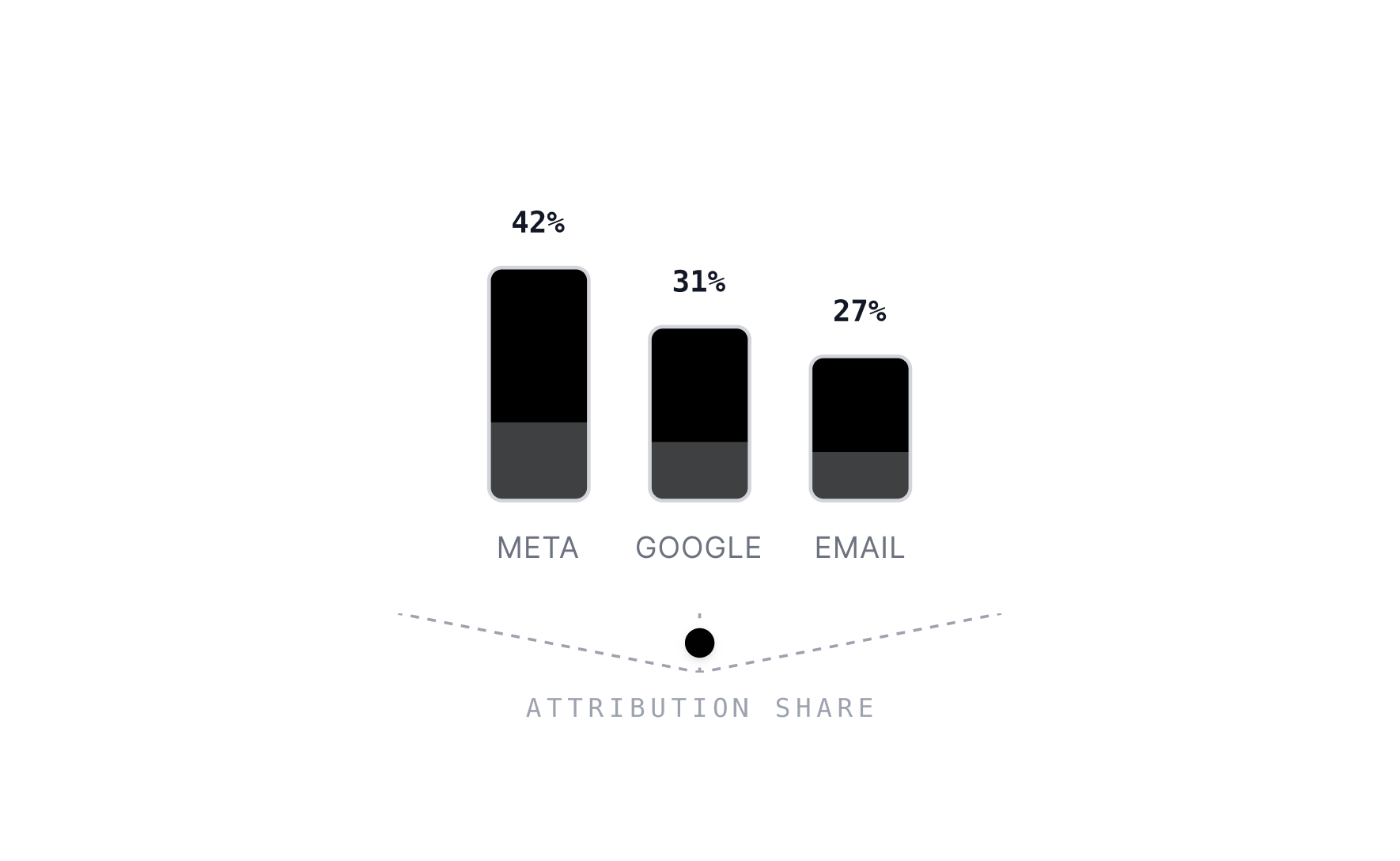
On this complete basis, the AI attribution evaluates each journey individually and weights every touchpoint by its true contribution to the conversion, instead of crediting everything to the last click. This makes it visible which channel kicks off a journey and which one closes it. For a detailed look at how the value of a conversion is distributed across the contact points, read the article on attribution models.
In the Customer Journey dashboard you see each customer's complete journey across all channels, which touchpoint held which share of the conversion and where budget truly works. Combined with AI attribution and GDPR-compliant hybrid tracking, the customer journey stops being a gut feeling and becomes a measurable basis for decisions.
Case Study: Dogs n Tiger cuts CPO by 20 percent
Just how much a complete journey analysis delivers is shown by the petcare shop Dogs n Tiger. Through end-to-end analysis of the customer journey, the brand gained deep insight into its customers' behavior, identified the highest-impact touchpoints and reallocated budget specifically toward them. The result: cost per order (CPO) reduced by 20 percent and noticeably higher customer retention.7 The full Dogs n Tiger case study shows the approach in detail.
Frequently asked questions about the customer journey
What is the customer journey in simple terms?
The customer journey is a customer's entire journey with your brand, from first awareness through purchase to referral. Every contact point along the way, such as an ad, a search or a newsletter, is a touchpoint.
Which phases does the customer journey have?
For performance marketing, three phases up to purchase matter most: awareness, consideration and conversion. The model traces back to AIDA; classic variants add further post-purchase phases such as retention and advocacy.
What are touchpoints in the customer journey?
Touchpoints are all the points of contact between customer and brand, online and offline: social ads, product pages, emails, retargeting, customer service, reviews. On average, consumers use around 8 such channels per journey.
How can you track the customer journey?
Through a combination of GDPR-compliant tracking, which captures data even without consent to third-party cookies, and data-driven attribution, which weights every touchpoint by its true contribution. That way the entire journey becomes visible, not just the last click.
Why is the customer journey hard to measure today?
Since Apple's ATT and mandatory consent, a large share of contact points is missing from standard analytics, and in Germany only around 47 percent of iOS users opt in to tracking. Without complete data, the journey stays full of gaps.
Conclusion
Understanding the customer journey is the foundation for smart, efficient marketing decisions. When you know the phases and touchpoints your customers really buy through, you invest budget where it has the greatest leverage, instead of going by gut feeling.
The prerequisite is making the entire journey visible in the first place, including the half that standard analytics no longer sees since ATT and mandatory consent. This is exactly where Tracify comes in, with complete, GDPR-compliant tracking and data-driven attribution, so the customer journey becomes a measurable basis for growth.
- Salesforce – State of the Connected Customer, 6th Edition (Oct. 2023): salesforce.com/resources/research-reports/state-of-the-connected-customer
- McKinsey & Company – The value of getting personalization right—or wrong—is multiplying (Nov. 2021): mckinsey.com/…/the-value-of-getting-personalization-right-or-wrong-is-multiplying
- Think with Google – Decoding Decisions: The Messy Middle of Purchase Behavior (2020): thinkwithgoogle.com/…/Decoding_Decisions_The_Messy_Middle
- AppsFlyer – ATT opt-in rates, three years on (26.04.2024): appsflyer.com/company/newsroom/pr/att-data-findings
- CNBC – Facebook says Apple iOS privacy change will cost $10 billion this year (02.02.2022): cnbc.com/2022/02/02/facebook-says-apple-ios-privacy-change-will-cost-10-billion-this-year.html
- Qualtrics – Customer Journey Stages: The Complete Guide (2024): qualtrics.com/articles/customer-experience/customer-journey-stages
- Tracify – product details, metrics and Dogs n Tiger case study (first-party, as of 2026): tracify.ai